
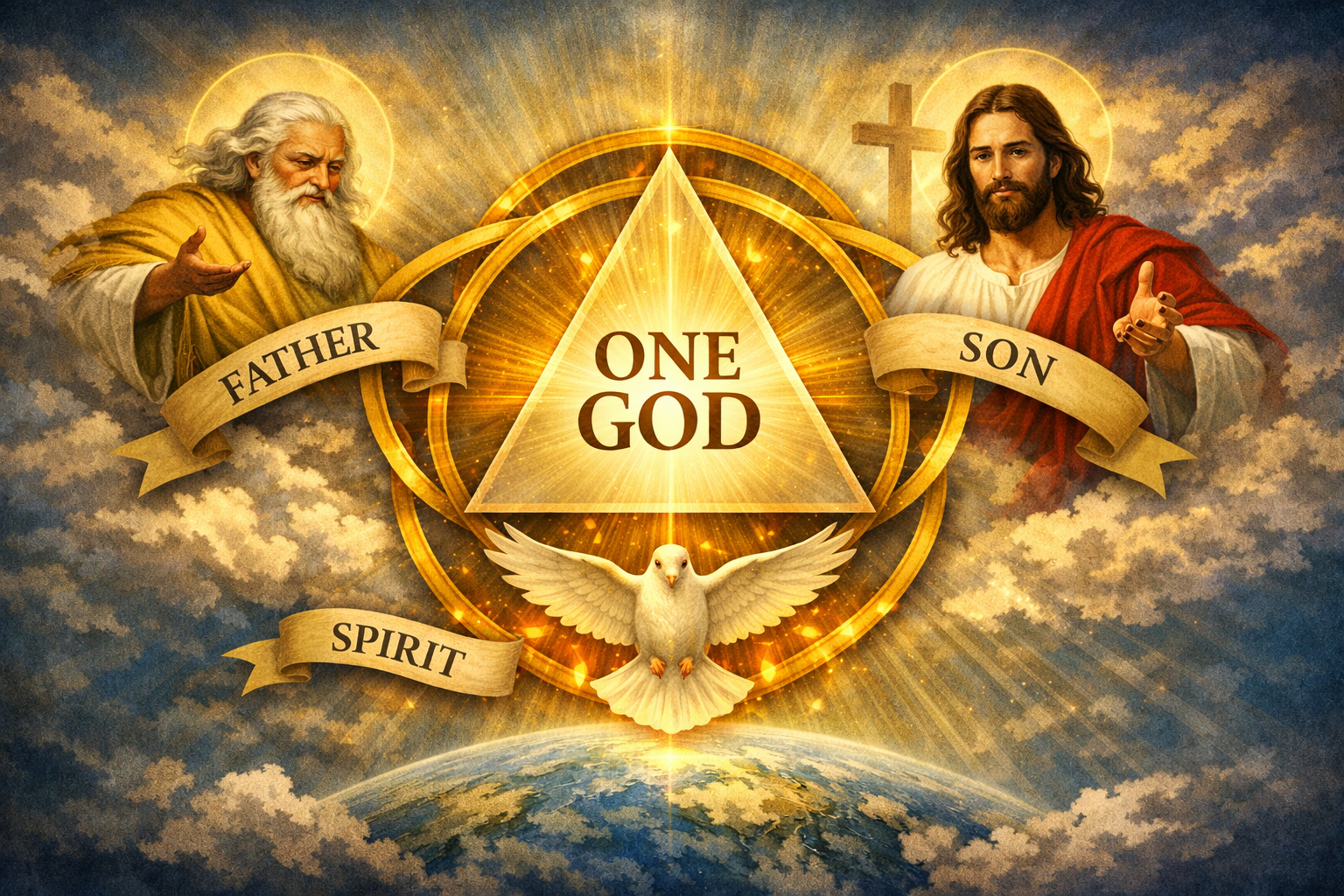
The “Three-in-One Mystery” Explained
Introduction: Imagine standing at the edge of the ocean, gazing at its vastness. You know it is water, yet it moves in waves, rises in tides, and reflects the sky in countless shades. The doctrine of the Trinity is like that ocean—one essence yet expressed in three distinct persons. For centuries, Christians have confessed: “We worship one God in Trinity, and Trinity in Unity” (Athanasian Creed). But what does this mean, and how can Scripture shed light on this profound mystery?
The Unity of God
The starting point is clear: the Bible insists on the oneness of God. “Hear, O Israel: The LORD our God, the LORD is one” (Deuteronomy 6:4). This foundational truth anchors Christian monotheism. There is no division in God’s essence; He is one in being, eternal, and sovereign.
The Distinction of Persons
Yet within this unity, Scripture reveals three distinct persons: Father, Son, and Holy Spirit.
- The Father: Creator and source of all. Jesus prays, “Father, glorify your name” (John 12:28).
- The Son: Fully divine, yet distinct. John opens his Gospel: “In the beginning was the Word, and the Word was with God, and the Word was God” (John 1:1).
- The Spirit: The divine presence who empowers and sanctifies. Jesus promises, “The Helper, the Holy Spirit, whom the Father will send in my name, he will teach you all things” (John 14:26).
These are not three gods, but three persons sharing one divine essence.
The Interplay of Unity and Diversity
The Trinity is not a puzzle to be solved but a mystery to be embraced. The Father sends the Son (John 3:16), the Son accomplishes redemption, and the Spirit applies it to believers (Romans 8:9–11). Their roles are distinct, yet their work is perfectly united.
A striking moment occurs at Jesus’ baptism: “The heavens were opened… and the Spirit of God descended like a dove… and a voice from heaven said, ‘This is my beloved Son’” (Matthew 3:16–17). Here, Father, Son, and Spirit are revealed together in harmony.
The Trinity and Christian Life
The doctrine is not abstract theology—it shapes how believers live. Paul blesses the church with: “The grace of the Lord Jesus Christ, the love of God, and the fellowship of the Holy Spirit be with you all” (2 Corinthians 13:14). This shows that the Trinity is the heartbeat of Christian faith:
- The Father loves,
- The Son redeems,
- The Spirit empowers.
Even prayer reflects this reality—we pray to the Father, through the Son, in the Spirit.
Conclusion
The Trinity is the mystery at the center of Christianity: one God, three persons, united in love and purpose. It is not a contradiction but a revelation of God’s richness. Just as light refracts into three colors yet remains one beam, so God shines as Father, Son, and Spirit.
To grasp the Trinity is not to master it intellectually, but to be drawn into its reality. The invitation is simple: worship the Father who loves you, the Son who saves you, and the Spirit who dwells within you. In doing so, you step into the eternal communion of God Himself.

Pingback: Your Teen Has a Secret Digital Life—And It’s Not on Their Home Screen - TESTIFY HUB