Two Yeshuas: The Choice the Crowd Didn’t Realize They Were Making
One of the most profound and unsettling moments in the trial of Christ happens so quickly in the Gospel narratives that modern readers often miss the full weight of its irony.
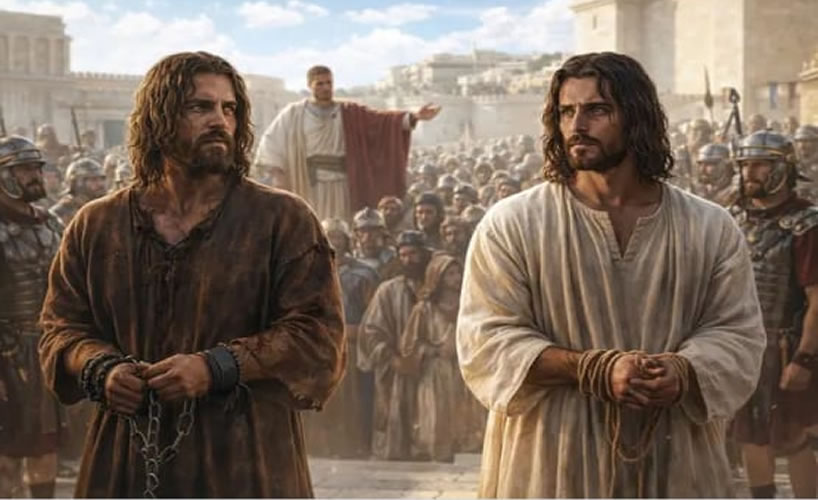
Pilate, standing before a restless crowd, offers them a customary Passover choice: release one prisoner, condemn the other to the cross.
“Which one do you want me to release to you?” (Matthew 27:17)
On the surface, the choice seems straightforward. They must choose between Yeshua of Nazareth and a notorious prisoner named Barabbas. But in some of the earliest manuscripts of the Gospel of Matthew, the choice is revealed to be far more chilling, because Barabbas is introduced with a first name.
His name was Yeshua Barabbas.
The question Pilate was truly asking the crowd was this: Which Yeshua do you want? Yeshua Barabbas, or Yeshua who is called the Messiah?
The Tale of Two “Sons”
Names in Scripture are rarely accidental; they carry deep theological significance.
- Yeshua translates to: “YHWH saves.”
- Barabbas translates to: “Son of the father” (Bar meaning son, Abba meaning father).
Standing before the crowd was a man whose very name meant: “YHWH saves, the son of the father.” Beside him stood the true Savior, the eternal Son of the Father. Two men. Two “Yeshuas.” Two vastly different visions of salvation.
Barabbas was not a petty thief. The Gospels paint a clear picture of a violent insurrectionist. Matthew calls him a “notorious prisoner” (Matthew 27:16). Mark and Luke explicitly state that he had committed murder during a rebellion against Rome (Mark 15:7; Luke 23:19). John refers to him using a term often reserved for revolutionary zealots (John 18:40).
Barabbas was exactly the kind of “messiah” many in first-century Israel were praying for. He represented armed resistance, political liberation, and earthly power.
Two Visions of Salvation
When the crowd chose Barabbas, they were not merely picking a random criminal to walk free. They were choosing a man who embodied the deliverance they expected, while actively rejecting the One who came to bring the redemption they desperately needed.
Consider the contrast between the two men standing before Pilate:
- The Revolutionary (Barabbas): Offered a salvation built on power, force, and shedding the blood of his enemies to secure a temporary, earthly kingdom.
- The Redeemer (Yeshua of Nazareth): Offered a salvation built on surrender, grace, and shedding His own blood to secure an eternal, heavenly kingdom.
The quiet Messiah from Nazareth spoke of loving enemies and forgiving transgressors. He did not come to save Israel from Rome; He came to save humanity from sin and death. To a crowd desperate for a political conqueror, this spiritual redemption was a stumbling block.
When Pilate presses them, “Which of the two do you want me to release to you?” their answer is deafening: “Barabbas.”
Release the revolutionary. Crucify the Redeemer.
The Breathtaking Exchange
The irony of this moment is both breathtaking and tragically beautiful. The guilty man goes free, and the innocent man takes his place. Barabbas deserved the cross; Yeshua did not. Yet, the physical wood that was likely measured and built for Barabbas becomes the very cross upon which the Son of God is crucified.
This historical moment is not just a political tragedy—it is the entire Gospel summarized in a single, vivid tableau.
It is the doctrine of substitutionary atonement played out in real-time. The guilty walks away unpunished because the Righteous One is condemned in his stead.
The Mirror of Barabbas (Author’s Reflection)
There is something about this moment in the Gospels that should stop every believer in their tracks.
When we read the story of Barabbas walking free while Yeshua walks toward Golgotha, we are not just watching ancient history unfold. We are watching our own story.
Barabbas deserved that cross. Everyone in the courtyard knew it. The Romans knew it. The Jewish leaders knew it. Barabbas himself certainly knew it. Yet somehow, in the most painful and profound exchange imaginable, the guilty man walks out into the sunlight while the innocent man is led away to be slaughtered.
If we are intellectually and spiritually honest, every single one of us stands in the exact place of Barabbas.
- We all have histories we cannot undo.
- We all have words we wish we could take back.
- We have all chosen the darkness of our own rebellion over the light of God’s Kingdom.
As the Apostle Paul plainly writes: > “For all have sinned and fall short of the glory of God.” (Romans 3:23)
The story of Barabbas is a living, breathing picture of grace. The cross meant for the rebel becomes the cross of the Son of God.
One cannot help but wonder if Barabbas ever looked back. Did he ever stand on the outskirts of Jerusalem and look up at that hill? Did he ever realize that the execution he narrowly avoided was the very instrument through which the Messiah was redeeming the cosmos? Did that realization ever bring him to his knees?
Because the ultimate truth of the Christian faith is that every person who comes to Yeshua eventually experiences that exact same, shattering realization:
That cross was meant for me. And He took it anyway.